


When a sliding glass door starts grinding, dragging, or refusing to move smoothly, the track is often blamed first. Sliding door track Replacement is usually necessary when the travel surface is severely bent, deeply worn, cracked, heavily deteriorated by corrosion, loose from its mounting area, or damaging rollers repeatedly.
However, dirt, minor wear, roller problems, incorrect adjustment, and alignment issues do not automatically mean the track needs replacing. In our experience, we often find that the visible track is not the real source of resistance until we inspect the rollers and the complete door system.
Track Condition | Repair May Be Possible | Replacement May Be Necessary |
Dirt and debris | Usually | Rarely |
Minor surface wear | Often | Sometimes |
Worn roller contact area | Sometimes | Depending on severity |
Bent track | Minor damage only | Severe deformation |
Corrosion | Surface deterioration | Significant material loss |
Cracked track | Rarely | Often |
Loose or separated track | Sometimes | Depending on mounting damage |
Repeated roller damage | Diagnose first | If the track causes repeated damage |
Hire a professional to determine whether your damaged track can be repaired or needs complete replacement.
The track is not simply a metal strip beneath the glass panel. It forms the running surface that the door’s rollers depend on.
The basic relationship is:
Door panel → rollers → track → smooth movement
When that relationship works correctly, the rollers carry the panel and travel along a relatively consistent surface. When the track becomes damaged, the rollers encounter resistance or lose proper contact.
That can create symptoms such as:
This is why replacing rollers without inspecting the track can produce disappointing results.
A worn roller can create similar symptoms. So can debris packed into the track. The location and pattern of the resistance provide useful clues.

This is one of the most useful clues during a track inspection.
If the door moves reasonably well and then suddenly becomes difficult at one particular location, inspect that section closely. A dent, raised edge, worn section, or obstruction can interfere with the roller precisely at that point.
By contrast, worn rollers often produce rough movement across a larger portion of the travel.
A practical test is simple. Clean the track thoroughly, then move the door slowly from one end to the other. Pay attention to exactly where the resistance begins.
If the problem occurs at the same physical location after cleaning and roller adjustment, the track deserves closer inspection.
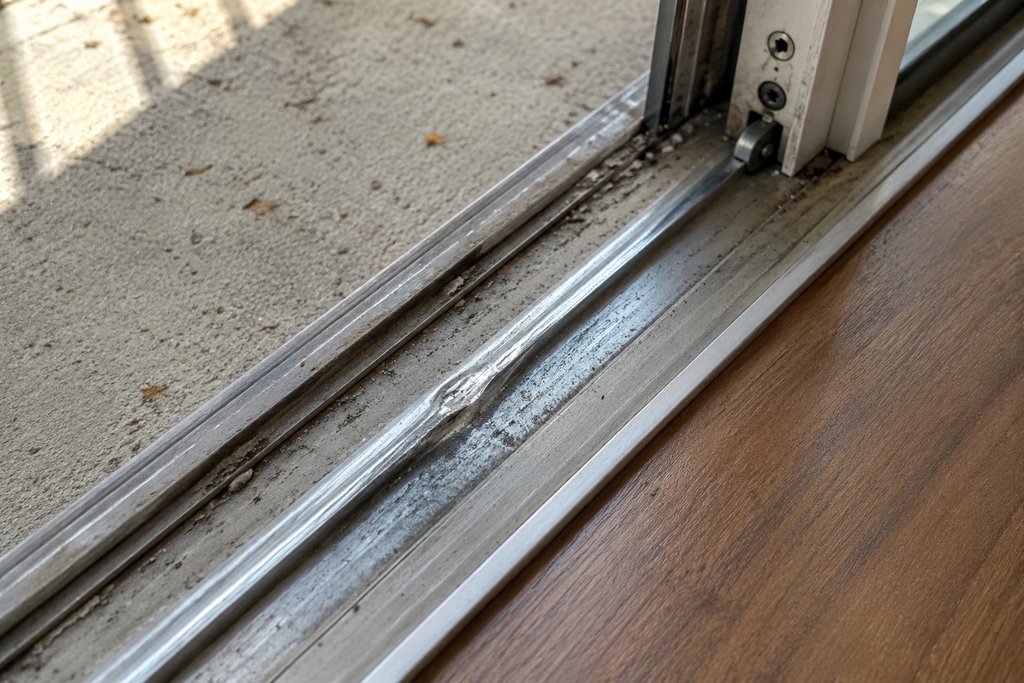
A sliding door track takes repeated contact from the rollers. Small damage can develop from debris, impact, cleaning tools, or general wear.
Look for:
A small imperfection does not automatically justify replacement. Some minor damage can be corrected depending on the track design.
However, forcing a badly distorted track back into shape can weaken the metal or leave another uneven section. This is where sliding glass door track repair may be appropriate for minor damage, while replacement becomes more practical for severe distortion.
This Old House’s June 2026 guidance specifically recommends evaluating bends, dents, rust, debris, and loose components before deciding between repair and replacement.
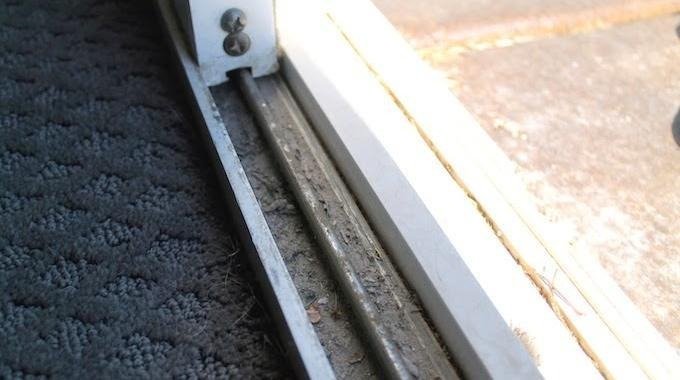
A dirty track is one of the easiest problems to mistake for track failure.
Sand, pet hair, leaves, and other debris can collect in the channel. That debris can interfere with rollers and make a properly functioning door feel damaged.
Start by removing the debris and cleaning the running surface.
Then test the door again.
If movement improves significantly, replacing the track may have been unnecessary. When the same rough section remains after cleaning, inspect that section for physical damage.
This distinction matters because replacing a track is considerably more involved than cleaning one.
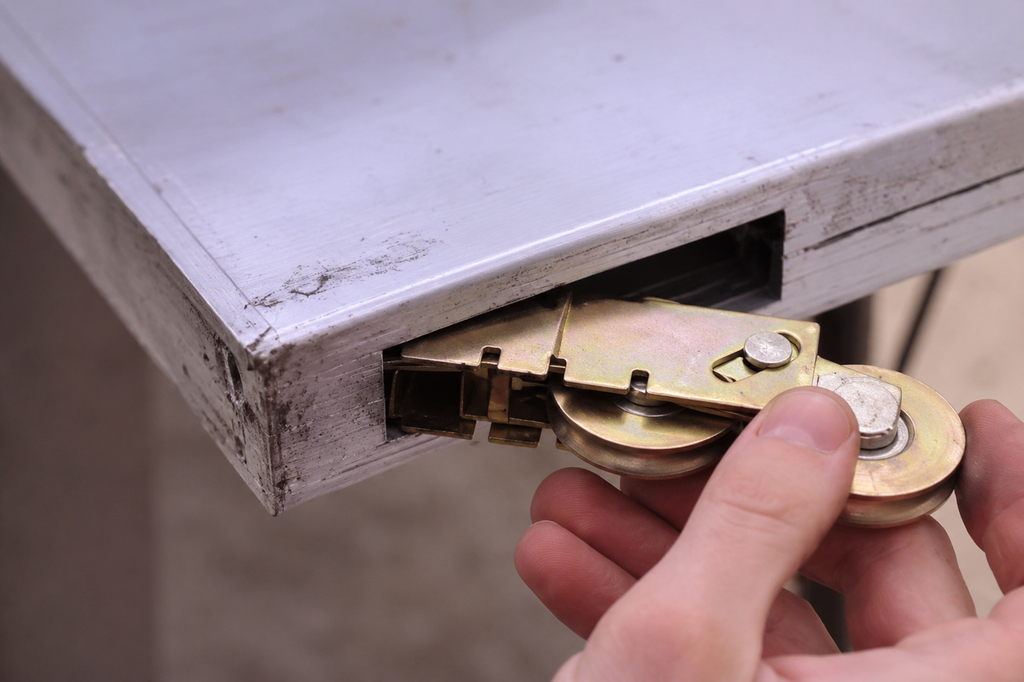
Replacing rollers can solve a genuine roller problem. It cannot repair a damaged running surface.
Consider a typical service scenario.
A homeowner notices that a heavy glass panel is difficult to move. The rollers are worn, so replacement rollers are installed. The door immediately feels better, but it still catches near the middle of the opening.
That remaining symptom changes the diagnosis.
The rollers may now be functioning correctly, but they are traveling over a damaged portion of the track. In this situation, continuing to adjust the rollers will not correct the underlying problem.
The next inspection should focus on the section where resistance remains.

A door that repeatedly comes off its track should not be ignored.
Several components can cause derailment:
The important question is why the door is leaving the track.
If the rollers are worn but the track is straight, roller replacement may solve the issue. If the rollers are good but one section of track is severely damaged, the track may be responsible.
When the frame itself is distorted, replacing the track alone may not solve the problem.
The entire system needs to be considered rather than replacing the first visibly worn component.
Don’t assume the track is the problem. Book an inspection of the rollers, track, frame, and alignment before choosing a repair.
This is where many sliding-door repairs go wrong.
The symptoms overlap.
Symptom | Possible Cause |
Door feels rough | Rollers or track |
Door is hard to push | Rollers, alignment, or track |
Door jumps | Roller or track problem |
Door rocks | Roller adjustment or frame |
Deep groove in track | Track wear |
Roller repeatedly fails | Track damage or roller problem |
Door scrapes | Alignment, frame, or track |
Door will not stay aligned | Rollers, frame, or track |
Resistance occurs at one spot | Track damage or localized roller issue |
Resistance occurs throughout travel | Rollers, alignment, debris, or track |
Notice that there is no single symptom that proves the track is bad.
That is why I prefer to test the door before recommending parts.
A homeowner may describe the problem as:
“My sliding door isn’t sliding smoothly.”
That tells me what the door is doing.
It does not tell me which component failed.
When a door becomes difficult to open, homeowners often search for sliding door roller replacement.
That makes sense because rollers are a common wear component.
The problem is that the track and rollers work together.
If the track has a deep groove, a severely damaged running surface, or extensive corrosion, new rollers still have to travel over that surface.
The opposite mistake happens too.
A homeowner sees a rough track and assumes it needs replacement when the rollers are actually worn.
That is why I keep coming back to the same principle:
Find the cause first. Replace the damaged component second.
The most expensive mistake is not necessarily choosing the most expensive repair.
It can be paying for the wrong repair and then having to pay again when the original problem remains.
Not every damaged track requires complete replacement.
Sliding glass door track repair may be appropriate when the problem is limited and the surrounding system remains structurally sound.
Repair may make sense when you have:
The key factor is whether the repair can restore a reasonably consistent rolling surface.
A track does not need to look brand new to work properly.
What matters is how the rollers travel across it.
Stop forcing a door that grinds, drags, or jumps off the track. Schedule an inspection and get the right repair for the problem.

Sliding glass door track replacement becomes necessary when damage is severe enough to interfere with reliable movement, alignment, mounting, or roller performance.
Dirt can often be removed, rollers can often be replaced, and minor damage may sometimes be repaired. Alignment problems can also mimic serious track damage.
In our experience, identifying the actual source of resistance is more important than immediately replacing the most visible component.
Before replacing a sliding door track, inspect the rollers, alignment, frame, and complete travel surface. A correct diagnosis can prevent replacing parts that were never the real problem.
No. Dirty tracks, worn rollers, poor adjustment, frame distortion, and alignment problems can produce similar symptoms. The most useful clue is often the pattern of resistance.
Current U.S. estimates vary considerably. This Old House lists roughly $75–$250 for a replacement track plus $400–$1,400 in professional labor.
Usually, minor repairs are less expensive than replacing an entire track. Cleaning, tightening, or correcting localized damage can involve relatively little material.
Yes. A roller that does not rotate correctly can place abnormal friction against the running surface.
Get personalized recommendations and professional installation support today.
Fast, dependable patio door solutions with expert installation, lasting performance, and exceptional craftsmanship.